The US government has offered the island state of Palau $200 million in aid if it agrees to resettle 17 Uighurs being held at Guantanamo Bay. Here are a couple links to some well-written articles on the matter.
As a quick background, these Uighurs (a Turkic Muslim people related to the Uzbeks inhabiting Xinjiang in Western China) were captured by bounty hunters in Afghanistan at the beginning of the so-called "War on Terror". They have been held in the prison camp at Guantanamo for the past seven years. All were cleared by the Bush administration of having any connection to terrorism, and they are not even labelled as "enemy combatants". A number of them were recently released and resettled in Albania, and the rest (the 17 in question) were ordered to be released into the US by a federal appeals court last year. Yet in prison they remain.
Much of the problem is due to the ignorance and fear mongering of American politicans. There was a massive outcry recently in Congress of resettling these "dangerous" individuals in the US, even though they have not been accused of any crime, and cannot return to China on fear of further torture and possible execution. Their crime in American eyes is to be Muslim, separatist, and potentially "radicalized" by their unjust prison experience. All this, even though the Uighur community in Northern Virginia has offered to take the men in and help them adjust to a normal life. As a result of these shortsighted, prejudiced, grandstanding actions by politicians concerned about whipping up a populist fear of the "threat" of Muslim foreigners, no European country will offer these men (or others at Guantanamo) asylum, and so they are being effectively exiled to a Pacific island.
As something of an international realist, I am just astounded by the base ignorance and stupidity of many of the supposed conservatives who oppose the Uighurs'. Very few of these politicians and pundits are friends of China (which they also fear). If conservative political leaders had something in the way of more brains, they would recognize a useful bargaining chip when they see it (remember all those "freedom fighters" in Afghanistan??) to check China's political influence, and to weaken control of the PRC's West. That, plus the fact that they used to support a president (Bush) who said a great deal about aiding peoples struggling against tyranny.
Apparently all that talk of freedom was yet another cynical ploy. These people just give in to the atavistic urges of ignorant, fear-mongering nativists. Too bad they still have such a corrosive influence on this country's government and its values.
UPDATE: Four of the Uighurs have just been released and are being transferred to Bermuda. Perhaps they can start a shell company there. The five sent to Albania in 2006 are still there, not pursuing criminal or terrorist activity.
11 Jun 2009


8 Jun 2009
Anti-Terror Laws and Moral Equivalency
This post from the Washington Monthly, while perhaps not saying anything new, is a very nice summarization of all the problems with how "terrorism" is defined in the United States.
Big Mistake
It looks like the al-Shabab in Somalia is seriously pushing for war with Sufis.
"They see Wahhabism as foreign and ultimately un-Islamic."
Talk about overplaying your hand...
"They see Wahhabism as foreign and ultimately un-Islamic."
Talk about overplaying your hand...
Long Road to Recovery

After a long search through various resources (as well as some number crunching of my own), I finally found some summarized figures on the effect of the economic transition on Post-Soviet states.
The above graph is based on numbers from the UN Statistics Division (admittedly the wiki-user didn't specify if GDP is in current or constant dollars, or is adjusted for PPP - and I'm not even sure how the UN calculated any GDP for the USSR, since I believe the Soviets did not keep such records). I'm a little suspicious of the late 1980's spurt in Soviet economic output - I thought that this period showed stagnation, followed by the chaos of perestroika. If Soviet GDP was more stagnant, then the change between 1990 and 1991 isn't so abrupt (which leads me to believe that these figures are in current prices after all). There are further IMF numbers in the sub-article that are also illuminating. Needless to say, things were bad.
In any case, it looks like in toto the former Soviet states only just reached their 1990 output levels in the past couple years. And considering that most of their recovery has been based on either resource extraction and/or foriegn-denominated loans, I'm sure the world recession is hurting them all quite badly. Apparently Russia's recession rivals its downturns in the early 90s and in 1998.
UPDATE: I double-checked and the GDP figures cited in the graph are indeed in current prices.
European Elections
The results are in for the elections to the European Parliament.
The BBC has some neat flash infographics here. The obligatory wiki background here.
Admittedly, despite having actual academic training in the structures of the EU, I constantly find myself forgetting just what the Parliament does, besides moving between Brussels and Strasbourg twice a year. I'm sure most Europeans feel the same way, which is why turnout was so low.
The interesting thing to check out is the current results compared to past results. The political left seems to be significantly declining across much of Europe. In this election, it seems that the big winners are the Christian Dems, the conservative Euroskeptics and the far-right nationalists (who might try to reconstitute a new European party, after "Identity, Tradition and Sovereignty" collapsed in November 2007).
What interests me is that the Greens and the Liberals seem to have done quite well. Perhaps there is a bright European future for greens and quasi-libertarians?
4 Jun 2009
Item

I was tempted to start things off with an item about Death Camps in the American South, but how about something lighter?
Item: Russian intelligence "expert" predicts that the United States will collapse and be split up between competing foreign powers.
I think that if central government collapsed, the former United States would more likely split up into independent entities along regional lines, as above.
I forget what the exact publication was that inspired this map of American regions: it was published by the US Information Agency (a propaganda arm of the CIA that is legally forbidden to operate within the US...I found this in Peace Corps days). FYI the blue spots are urban areas that do not fit into any region. Independent city states, perhaps?
Oh, and the death camps are here.
Reborn!
Welcome one and all!
The Notes from Underground blog, after a two year silence, has been resurrected. The format has been retooled and streamlined somewhat. It pains me to remove the Russian language labels, but I assume that they have been utterly incomprehensible to most readers, and I aim to improve accessibility.
The focus of this blog will also shift somewhat from its earlier incarnation. While I will post on whatever random thoughts cross my mind, or whatever tidbits of information pass before my eyes, the goal of this blog will be to initiate, facilitate and accommodate more general discussions. To this end, open threads will be thrown out on a regular basis to the readership.
Welcome back, and enjoy!
11 Jun 2007
China and Free Trade
Sorry, I guess I'm on a free-trade kick this evening:
The BBC mentions the following report on Chinese labor standards published today by the campaigning alliance Playfair. I must say that one should be a little skeptical of an alleged research organization that is actually funded by a confederation of trade unions under the "fair trade" banner.
I notice that these Western organizations only find time for "awareness" when the working conditions are in factories producing Olympics merchandise. I also find it interesting that there are no voices of Chinese workers calling addressing workplace law violation: only Western campaigners speaking on their behalf. Much like how the Chinese Communist Party speaks for the workers' interests...
I am sure work in a Chinese factory is intense, with long hours, forced overtime, and perhaps even labor with children as young as 12. But as James Fallows points out in his excellent piece on Chinese industry in Shenzhen, Chinese peasants willingly leave their families and drudging agricultural toil behind to work in such jobs. They save money for a few years and then often return home in the hope of starting businesses. This is a hard life, but its the life of millions of people striving for and building a richer future through industrial revolution, just has America and the West did a century and a half ago. Fallows also mentions that Western campaigners have a tendency to misinterpret Chinese labor conditions, like when campaigners see computer assemblywomen grounded with wires to prevent static electricity buildups and think that they are chained to their stations as slave labor. Nor do these same campaigners seem to have much to say about non-export industries, like when 33 workers were incinerated at a government steel plant because of faulty equipment.
Those concerned about working conditions in China would better spend their energies supporting the Chinese themselves in building a society and legal system that better protects property and civil rights. If Chinese workers were free to organize for themselves outside of the Communist Party structure, they certainly would not need meddling foreigners deciding which of their workplaces were bad for them.
"A Reply from Your Congressman"
 I got this junk mail in my inbox this week:
Thank you for contacting my office regarding H.R. 891, the Dog and Cat Fur Prohibition Enforcement Act. I always appreciate hearing from my constituents, and I share your concern on this important issue. I hope you will be pleased to know that I am a co-sponsor of H.R. 891.
As with any consumer product, the buyer has a right to know what they are purchasing. The inhumane practices exercised on animals in foreign countries for consumer products must be stopped and the United States government has the responsibility to do whatever possible to prevent the manufacture and sale of this animal fur. As you may know, I was a supporter and co-sponsor of the Dog and Cat Protection Act of 2000, prohibiting the imports or exports of products containing dog or cat fur into or out of the United States.
The Dog and Cat Fur Prohibition Enforcement Act will expand upon the Dog and Cat Protection Act of 2000 and effectively ban the import, export, and manufacture of raccoon dog fur in the United States. H.R. 891 will also require the labeling of all fur products. This will protect the raccoon dog species, as well as protect consumers from purchasing unlabeled or misidentified animal fur products. It is for these reasons that I am a co-sponsor of this bill. Please be assured that I will continue to support this bill, as well as any future legislative initiatives to promote animal welfare and prevent inhumane treatment of all animals.
Thank you again for sharing your thoughts with me. Please feel free to contact my office if I may be of assistance to you in the future. Sincerely, Michael E. Capuano Member of Congress
Here is my emailed response:
Dear Rep. Capuano,
While I thank you for your correspondence, I feel I must clarify that I never contacted your office regarding H.R. 891. I am worried that someone is misrepresenting me to you in regards to official correspondence.
While I am an animal lover and ardent naturalist, I question the need for bill H.R. 891 (the Dog and Cat Fur Prohibition Enforcement Act). The Raccoon dog is not an endangered species, nor is it even a true dog. While I would hope that its fur is harvested in as humane a manner as possible, I do not feel that it is the place of the House of Representatives based on these concerns to limit this fur trade with other nations in possible violation of the United States' commitments as a member of the World Trade Organization. I believe that you and other US representatives should seriously consider the arguments that the raccoon dog fur trade increases habitat conservation, limits illegal poaching, and supports native Siberian peoples such as the Evenk who engage in fur farming.
If the House of Representatives is concerned about endangered species conservation, I would advise them to research strengthening CITES and international agreements regulating the sale of endangered animal products. I would also urge the House to consider promoting market tools as a means of protecting endangered species, rather than banning the market outright.
Finally, I would heartily urge you as my Representative in Congress to pressure other members of the House into focusing on more worthwhile projects: instituting a federal cap-and-trade system of carbon emissions, thoroughly investigating the curtailment and abuse of civil and human rights in the "Global War on Terror", curbing the practice of earmarking and Congressional pork-barrel legislation, balancing the federal budget and reducing the deficit, establishing independent congressional districting commissions to end the gerrymandering of Congressional districts, extending the Presidential "fast-track" authority in negotiating free-trade agreements and urging the current administration to commit itself to a comprehensive world trade agreement as initiated in the Doha Round.
Thank you for welcoming the thoughts and concerns of one of your constituents.
(Signed, the Editors at The Economist...)
No Place Like America II
At least some people in this country will come to their senses. I found the most interesting remark on the Paris Hilton jail scandal on a BBC forum from a Nigerian man. He mentioned that in his part of the world, children of the rich and powerful scamming their way out of jail sentences is just part of the justice system. That's rough when our legal system gets realistically compared to that of a failed oil-state in sub-Saharan Africa.
At least someone finally sent her back to jail for her "learning experience". Luckily for all of us, Paris has replaced the Supreme Court and the Constitution and has self-arbritrated on the legitimacy of the sentence. Too bad she is kept in luxurious facilities separated from the general population. Also too bad she isn't at a hard labor camp in a country that wouldn't even care who she was.
At least someone finally sent her back to jail for her "learning experience". Luckily for all of us, Paris has replaced the Supreme Court and the Constitution and has self-arbritrated on the legitimacy of the sentence. Too bad she is kept in luxurious facilities separated from the general population. Also too bad she isn't at a hard labor camp in a country that wouldn't even care who she was.
No Place Like America
I'll try not to get too depressing, but you really have to admit that sometimes the news from this country is just baffling and shocking.
The overall trend in firearm fatalities has been declining in this country in recent history (see chart). Nonetheless, it appears that in recent months there is some spec tacular countervailing anecdotal evidence. There was April's terrible shootings at Virginia Tech (did they ever fully straighten out the chain of events in that episode?). A month later there was a multiple-fatality sniper attack in Idaho. And now recently there has been another serial shooting in Wisconsin. One must admit, there seems to be something of an upsurge in this kind of violence these days. Boston last year saw quite a bit of gun and gang-related violence. But these incidents seem to involve many fatalities coming from one shooter, and seem to occur in suburban or rural areas.
Now, I am not going into the details of the gun debate, except to say that European friends that I have spoken with cannot comprehend how guns exist at all in common American society. I am not as opposed to guns as all that, although I think some restrictions cannot hurt, as long as sporting and hunting needs can be met. Likewise I think that some of the gun lobby's arguments for guns are a little flimsy at best. An armed populace will never really stand up to a tyrannical government, especially as that government has more of the guns. The average Iraqi household has several machine guns in the residence. This neither stopped Saddam Hussein from using his greater firepower to rule the country, nor did it stop civil chaos and crime from running rampant after his fall. Also, I have a feeling that many of those who have guns for "self-defense" are probably a greater danger than the criminals that it is meant to deter.
At the same time, Washington DC' s gun ban was obviously a joke. So is the mess of gun legislation in both the federal and state levels of government. Arkansas forbids guns in church. Alaska allows free purchase and carrying of weapons. Florida forbids carrying of guns except when concealed. Massachusetts requires background checks, official safety training, a purchase permit, and has four separate levels of ownership permits, as well as disallowing anyone from other states to transport guns through the state. On top of that, different states recognize different licenses. And then there are federal laws, of varying levels of usefulness (it is illegal for illegal immigrants to own firearms ... how helpful). Honestly, I can't imagine why anyone would bother with this hassle to even legally carry a gun.
Some honest discussion of gun regulation would probably be useful, but then so would honest discussion about many issues in this country. Frankly, I think in terms of mass-shootings we need to look past gun issues and address the reasons why people are driven to these acts of destruction. It seems that mental health care in this country just isn't at the standard it should be, and is not reaching people who sorely need it the most. Likewise, sometimes one wonders if this the dark side to the suburban culture. Young and/or disturbed people who live closeted lives in artificial communities, and who live through consumerism and media products seem to be prone to some wild and dangerous behavior. And I'm not talking just about America. Take a look at Japan and its suicide obsession.
(Charts by Economist.com)
The overall trend in firearm fatalities has been declining in this country in recent history (see chart). Nonetheless, it appears that in recent months there is some spec
 tacular countervailing anecdotal evidence. There was April's terrible shootings at Virginia Tech (did they ever fully straighten out the chain of events in that episode?). A month later there was a multiple-fatality sniper attack in Idaho. And now recently there has been another serial shooting in Wisconsin. One must admit, there seems to be something of an upsurge in this kind of violence these days. Boston last year saw quite a bit of gun and gang-related violence. But these incidents seem to involve many fatalities coming from one shooter, and seem to occur in suburban or rural areas.
Now, I am not going into the details of the gun debate, except to say that European friends that I have spoken with cannot comprehend how guns exist at all in common American society. I am not as opposed to guns as all that, although I think some restrictions cannot hurt, as long as sporting and hunting needs can be met. Likewise I think that some of the gun lobby's arguments for guns are a little flimsy at best. An armed populace will never really stand up to a tyrannical government, especially as that government has more of the guns. The average Iraqi household has several machine guns in the residence. This neither stopped Saddam Hussein from using his greater firepower to rule the country, nor did it stop civil chaos and crime from running rampant after his fall. Also, I have a feeling that many of those who have guns for "self-defense" are probably a greater danger than the criminals that it is meant to deter.
At the same time, Washington DC' s gun ban was obviously a joke. So is the mess of gun legislation in both the federal and state levels of government. Arkansas forbids guns in church. Alaska allows free purchase and carrying of weapons. Florida forbids carrying of guns except when concealed. Massachusetts requires background checks, official safety training, a purchase permit, and has four separate levels of ownership permits, as well as disallowing anyone from other states to transport guns through the state. On top of that, different states recognize different licenses. And then there are federal laws, of varying levels of usefulness (it is illegal for illegal immigrants to own firearms ... how helpful). Honestly, I can't imagine why anyone would bother with this hassle to even legally carry a gun.
Some honest discussion of gun regulation would probably be useful, but then so would honest discussion about many issues in this country. Frankly, I think in terms of mass-shootings we need to look past gun issues and address the reasons why people are driven to these acts of destruction. It seems that mental health care in this country just isn't at the standard it should be, and is not reaching people who sorely need it the most. Likewise, sometimes one wonders if this the dark side to the suburban culture. Young and/or disturbed people who live closeted lives in artificial communities, and who live through consumerism and media products seem to be prone to some wild and dangerous behavior. And I'm not talking just about America. Take a look at Japan and its suicide obsession.
(Charts by Economist.com)
9 Jun 2007
The Latest News From the Steppe
 I must say - for a country that is so unknown to the West (or at least to Britain and America) that Sacha Cohen's Borat stunts can be passed for real, Kazakhstan has been figuring pretty highly in the news these days.
First, the First President of the Republic of Kazakhstan (as he is officially commemorated in state museums, despite him remaining the only president) has been elected as President for Life. I wasn't aware that heads of state were still offered this title, besides Castro. And look where that got him.
Still, life is complex. There are some decent reforms that were proposed in this package of legislation, like restricting the constitutional amendment process and streamlining elections. Unfortunately, theory is different from reality in the former Soviet Union. But then this is true for the other side of the ideological spectrum: Turkmenistan and Uzbekistan are even more brutal regimes than Kazakhstan's, but I am not sure that any are exactly "totalitarian", however true dissidents' criticisms of them may be. As for Nazarbayev himself, I believe (and have heard to this effect) that his true role model is Lee Yuan Kew of Singapore.
Second, and in related news to the first item: the president's son-in-law has been arrested. This is related to murky clan struggles among the power elite. In true post-communist fashion, the President's son-in-law was Ambassador to Austria and the OSCE, owner of the country's largest newspaper and television station, and director of one of the country's biggest bank. He is accused of abducting and beating two other bank directors, one of whom remains missing. Talk about the convoluted world of the new post-Soviet elite! His quote on BBC (unfortunately for Anglophones in Russian) is priceless:
"As the Republic's ambassador to Austria, I represent the interests of my government, president and my country. I think that the first president of Kazakhstan has done very much for the country ... But as a private citizen, I have my own vision for the development of Kazakhstan."
(I believe that this is called a "conflict of interest")
Third, Russia is apparently getting keen on its Central Asian neighbors, and has been in a frenzy of investment in Kazakhstan, as well as other portions of Central Asia. Putin last month snatched a pipeline deal with Turkmenistan and Kazakhstan that upset Western plans, and apparently also is looking for uranium from Kazakhstan. The Great Game continues.
The former Soviet Union never ceases to surprise (as well as to frustrate). Georgia, Ukraine and Kyrgyzstan have had revolutions in the past four years, as well as more democracy - or instability, depending on how you look at it. Georgia has been blockaded by Russia and ethnic Georgians expelled from Moscow, Ukraine's President and Prime Minister are refusing to recognize each other's existence and are arraying their loyalists, and Kyrgyzstan's Prime Minister was poisoned.
Meanwhile, Russia is getting more assertive with it's Cold War lite - witness Putin's mini-Reykjavik moment of cooperation today, now that Bush offers to treat him like Reagan did Gorbachev.
But still, times have changed - Russia's enemies are not the Americans (so much), or even West Europeans, but their own near abroad. Russians seem to have collectively always been xenophobic, but now it strikes closer to home. A recent survey found that the following percentages of respondents considered these countries among Russia's enemies:
60% - Estonia, 46% - Georgia, 36% - Latvia, 35% - USA, 32% - Lithuania, 23% - Ukraine.
Countries considered among Russia's friends?
38% said Belarus, and 39% said Kazakhstan.
Waterways of East Cambridge
I'm not going to lie: my obsession with geography means I also have a big interest in waterways of various kinds. Here are some pictures from two afternoon walks on Wednesday. Consider it your walking tour: The Zakim Bridge from outside my office. Looking through a chain-link fence and over the superb North Point Park, complete with playground, skating park, open green space, and beds of different species of flowers that have been combined so that their combined blooms have lasted over three months now. This being Boston, local bureaucracies are fighting over the park's liability and it remains closed to the public.
 Broad Canal, looking towards Kendall Square
America will never fail to amaze at the number of times its people have completely reinvented their society and economy, despite their short history. True, Cambridge has always had Harvard. But 200 years ago it was also a bustling seaport, as canals such as Broad Canal stretched through the salt marshes up towards Central Square, and wharves lined the waterfront laden with agricultural goods. Broad Canal is still there, although nowadays it does not quite reach Kendall Square. The wharves have been replaced with M.I.T. properties and such biotech firms as Siemens and Genzyme.
 Cambridge Athenaeum
The deity herself watches over Memorial Drive.
 A relic of the industrial age.
 View towards Boston down the Lechmere Canal.
 The Zakim Bridge from outside my office. Looking through a chain-link fence and over the superb North Point Park, complete with playground, skating park, open green space, and beds of different species of flowers that have been combined so that their combined blooms have lasted over three months now. This being Boston, local bureaucracies are fighting over the park's liability and it remains closed to the public.
 Broad Canal, looking towards Kendall Square
 Cambridge Athenaeum
The deity herself watches over Memorial Drive.
 A relic of the industrial age.
 View towards Boston down the Lechmere Canal.
This piece of canal waterfront is now home to condos, sightseeing boats, lunching workers and that center of modern American society - the mall (Cambridgeside Galleria, to be precise).
 Millers River
Once this river flowed from Union Square in Somerville into Boston Harbor, and divided Charlestown from Cambridge. Now, it has been mostly filled in. What remains survives (with the last vestiges of Boston's precolonial saltmarshes) underneath the Zakim Bridge's US Interstate 93. I guess Boston is a bit like Tokyo. The numbers, by the way, mark the harbor depth at those spots when surveyed in 1801.
Little slivers of East Cambridge's past survive amongst great development: new biotech firms and their properties seem to be sprouting up all over the place. Harvard Square is so passe: what do those people ever do for anyone, except spend other people's money? This part of Cambridge seems to be the Biotech Silicon Valley of the East Coast. Some "money" shots:
 Genzyme

North American HQ of my Dear Employer
(note the Condos sign - so much for affordable housing!)
And last but not least:

A monument - to potatoes?
5 Jun 2007
Of Blogs, Souls and Politics...

I just finished reading a book called The Conservative Soul: How We Lost it, How to Get it Back, by Andrew Sullivan. The book left a significant enough reaction on me that I have a review for it.
I first became acquainted with the work of Andrew Sullivan through the Atlantic Monthly's website, which links to his blog, The Daily Dish. For those more removed from the Beltway, Sullivan was/is one of the premier political bloggers, and his blog was once among the most-influential in DC. He was an ardent supporter of Bush in the 2001-2003 years, allegedly becoming required reading for the White House staff. Beginning in 2004 he had a major falling-out with The Bush Administration (hereafter referred to as TBA) and has taken up blogger arms ever since then. I find his blog worth a quick view - he also tries to keep things interesting with YouTube clips of all sorts.
Anyways, with that background, I decided to read his book (free from the library, of course). And I must say that I have a very mixed reaction, perhaps inspired by my readings of reviews by his friend David Brooks and by the New York Review of Books.
Sullivan is a mixed bag, and while I will leave it to the above reviews to flesh out his story, here he is in a nutshell. He is a child of Irish immigrants to England, selected for a scholarship to Oxford, a doctoral student of philosophy, Tory activist, immigrant to America, youngest editor of The New Republic, openly gay and HIV positive, and a practicing Catholic, as well as being the blogger personality. This makes his life experiences and viewpoints eclectic, to say the least. This book was his attempt to make clear what a conservative is in his understanding, being himself a self-professed conservative.
His argument is as follows: a conservative is a person who sees the world through the lenses of skepticism and doubt, always questioning and listening to his conscience, and never believing in an ideology or any concept a priori. The conservative embodies the ideals of 16th century French philosopher Montaigne and 20th century British philosopher Oakeshott, and sees the world as a never-ending game of pool: one must consider play based on where the balls are placed, and one can never really control the consequences. The conservative above all values freedom and the strong but limited government that allows him the space to muse his lonely, sublime existence and to express himself as needs be.
The conservative is therefore threatened by the fundamentalist. Sullivan defines the fundamentalist as anyone who excepts some external set of values as a revealed truth, and who tries to bend himself and his world to fit into this truth. Such a person cannot tolerate other ways of thinking, and must either convert or destroy anyone who does not share his revelation. The fundamentalist is forever reaching back to that one moment of his conversion, and is governed by fear of sin, defeat, and by thoughts of the end-times.
All well and good, and at this point I'd like to say that I share many of Sullivan's more compelling philosophical thoughts, such as the inability of God to be defined by human presumption and the dichotomy between knowledge (and its limits) and (false) certainty - although Jacob Bronowski's discussion of the latter topic in his Ascent of Man is far better. Sullivan also provides some great philosophical arguments against those who would invoke "natural law" or the "culture of death" to colour debates about human biology, birth and death.
However, as Sullivan's colourful past can show, he has more than a few axes to grind, and when grinding them the quality of his writing slips. As the above reviewers observe, his book is high on philosophy and low on journalism. He doesn't really bother to get to know the fundamentalists in any meaningful manner. Christian fundamentalists are a series of Falwell quotes, references to American mega-churches and the "Left Behind" series, and rehashed research from fellow gay anti-fundamentalist provocateur Bruce Bawer. His knowledge of Islam and political Islamism is far worse, and one can see why his views on it were once so popular among neoconservative Republicans. In his mind, the Taliban, Iran and Saudi Arabia are all the same, where women are "domestic slaves" and gays have walls dropped on them - sadly true in instances, but ignoring the deeper complexities that make these or any non-Western society a real, rather than a rhetorical point. Likewise, he manages to conflate "fundamentalism" to mean anyone motivated to change the world by ideals, be it "Islamofascists" real fascists, communists, Dostoevsky's Grand Inquisitor, Christianists, Socialists, liberals, internationalists, international realists, Whigs...the list goes on. As David Brooks notes, this would seem to include the signers of the Declaration of Independence and the Civil Rights movement leaders in its logical conclusion, as well as anyone motivated by faith to perform works of good in the world. Brooks points out that poetry and philosophical skepticism are all well and good, but hardly make for a coherent and successful political movement.
But this is precisely the point. For all of Sullivan's personal philosophy, and in direct contradiction to the book's title, we never see what a conservative is, merely what this conservative does. We can very clearly substitute "conservative" for "Andrew Sullivan" and read his referral to himself in the manner of Caesar, and we would not be too far off the mark.
For clearly he sees himself in his actions as the embodiment of this "conservativeness" (never an -ism, please!). Him and his worthy pantheon: Jesus (naturally), Oakeshott (Sullivan's personal friend and the subject of his doctoral thesis), the equally obscure Montaigne (I have studied both philosophy and political science and blissfully never heard of these two before), and the larger-than-history Lincoln, Churchill, Reagan and Thatcher. History is not his strong point, and where Sullivan carefully reads the philosophy of his foes he botches the history of his heroes. Sorry, but the US military did not liberate eastern Europe from communism, not even with those Pershing missiles. But no mention of Gorbachev is even made in this book - Reagan just apparently won the Cold War in Reykjavik by himself. Churchill presciently warned about a mobilized postwar Britain being turned to - evil! - a social welfare state, one that only Thatcher could disspell: but Churchill himself was reelected as Prime Minister of this social democracy in the 1950s. Sullivan often twists history against itself: Jefferson is quoted both negatively and positively compared to Sullivan's viewpoints.
And perhaps here is the meat of the issue. This book is in large part an exercise in both the egoism of an elite thinker and convoluted mea cupla for why such a thinker played willing attack dog against war skeptics in the lead up to the 2003 Iraq invasion. Sullivan's most telling line on the subject:
"I can see the comedy and tragedy of an entire debate almost all of which was premised on what turned out to be a falsehood.... This falsehood was taken as fact by every major intelligence agency and by both supporters and opponents of a war to depose Saddam. We were all wrong."
Because, of course, we were all suckered, just like him. Unfortunately, I wasn't and I don't buy this attempt at an apology. He supported Bush when there was the need to question Bush, and it does no good now to say that, in fact, Bush isn't a real conservative but in fact the enemy of the conservatives. Sullivan is correct that TBA's executive power and willingness to torture are serious erosions of all our liberties. But most-favoured bloggers *ahem* calling in to question the patriotism and loyalty of those arguing against war in 2003 helped to get us there.
Furthermore, as the NYRB review notes, there is something of an Oxford-elitist tinge to his dislikes: he favors the familiar rituals in the village Catholic church for their own sake and unconnected to doctrine to the American megachurches and shopping malls. Fair enough, but the former seems to be something for Sullivan like what yoga has become - ancient rituals performed for a mind-clearing exercise by the urbane and educated rejecting any unpleasant or "unnecessary" cultural or doctrinal baggage. All you need to know is that this thinker is right and everyone else is wrong. Ironically, Sullivan himself often shows the zeal of the converted in his viewpoints.
Sullivan only cuts short his musings in the last ten pages, where he attempts to squeeze in that in addition to being a musing philosophy professor, the true conservative also supports free markets, the flat tax, gay marriage, marijuana legalization, preemptive war (but with a large international coalition), kite-flying, beer drinking, and of course blogging.
This book left me pondering the meaning and limitations of my existence, almost fainting trying to comprehend my own mortality. And it also served to show me why I should avoid political blogging where possible.
It Lives!
I realize that it has been quite some time since I posted, and at least one of the more devoted fans asked for some updates. It's been a busy couple of months or so, but I will try to keep things interesting.
I am seriously considering a shift or remake or whatever the blogger terminology is for revamping a blog. I know that the small readership that I have appreciates the rants that I have posted concerning politics, religion and history. But then again, let's lighten things up. And also I'd like to actually put myself into this blog a little more.
Check back from time to time for some changes.
2 Mar 2007
Banning Offensive Language
I was reading on BBC not too long ago that New York has decided to continue it's legislative activism. Apparently attempts to mold New York into a well-behaved American Singapore does not stop with the outlawing of smoking or of consuming trans-fats, but will now include a legal ban on the use of a certain perjorative term for African Americans.
While I agree that the use of such terms in youth culture is ironic, to say the least, as well as unfortunate from an historical perspective, I see what little good unenforceable city council resolutions do. I would be better if the New York City Council worried about fixing potholes and promoting racial harmony in schools than passing headline-grabbing motions such as this.
But my real indignation lies with an editorial that the BBC website published on the subject, written by BBC correspondent Kari Browne. I urge you to read this editorial, or at least the "Different Perceptions" conclusion at the bottom. I agree with her general thesis, but the fact that she tries to butcher etymology of the word "cracker" in order to claim that the persistence of this word - and the fact that many Southern whites willfully identify with this term - literally originates with the cracks of whips on the backs of slaves is quite frankly grotesque. It is exactly this twisting of history that gives otherwise worthy politically liberal viewpoints a bad name.
I wrote the following as a response to the BBC:
"Regarding Kari Browne's "Should Racist Word be Rehabilitated?", while I do agree with her main argument that words such as the "n-word" have a hurtful past that younger generations do not understand, I am not convinced by her etymology for the word "cracker". I am not one to question her great-grandmother, but as I understand it the term comes from an Elizabethan word "to crack", meaning to boast or brag - much as we "crack" jokes today. The term was applied in the 1700s to the Scots-Irish settlers of the upland South, who lived beyond the law and were considered "rascals" and "boasters" by the colonial governments and gentry. The term has also been explained as deriving from these settlers' habits of cracking corn and pecans, as well as whips when herding cattle. While these Southern whites did own some slaves, they were not the plantation slaveowning class of the South, and I think it is a bit of a stretch to connect the name "cracker" with lowland Southern slaveowners, or insinuate that the term implies dominance over another race."
I am sure that this response will never be read, let alone published or responded to. I am sure that in such circles I would be denounced for taking such a stand (how can I question her relative, the eyewitness to oppression, because this type of pseudohistory relies heavily on the personal and the anecdotal). But I feel that for all the blood and tears spilt over race relations in American history, the goal of coming to true harmony and equality between all the peoples and individuals of this country will not be helped but will be hindered by the invention of false oppressions, which will only serve to obfuscate and discredit the true injustices. Think "herstory" and "womyn" and you see where I am going with this.
I urge everyone to write a little note to the BBC to set them straight on their word history.
28 Jan 2007
Fun with Numbers
Well, it has been something of a slow news cycle. Apparently no one is interested in making much international or political news in the dead of winter (or Australian summer). Strikes in Lebanon and Guinea, State of the Union address by President Bush, it's all pretty much more of the same.
But the CIA has just put out their 2007 World Factbook. Understandably, their information is somewhat flawed and often at odds with other information and intelligence agencies (no I will not get into any political discussions here). With the Factbook this is largely due to them relying on local censuses and official statistics to fill out their information on every independent state and dependency. But their information is still a very useful rough guide, and seems to immediately and directly flow into Wikipedia. And of course once wikified, information is gospel truth.
So here is one of my latest graphics, showing the population and religion of every African country. This was just something I was thinking about, and slapped together. For the record, the population total for that continent is somewhere around 909,000,000 to put things in pespective.
 Obviously it is a little difficult to read this graphic...it looks much better as a spreadsheet than as a cut-and-pasted picture, for that I apologize. The countries are in alpabetical order. This is a work in progress - welcome to the internet, ladies and gentlemen.
Anyway, one reason why I say that this is a work in progress is because this graph has been a little lesson for myself in using OpenOffice, a suite of open-source programs offered by Sun Microsystems. OpenOffice operates more or less like Microsoft Office, but the coding is open source and it is offered to all for free. I recommend everyone give it a try.
19 Jan 2007
Political and Civil Freedoms Across the World
With the January news cycle being relatively slow, it is time for the talking heads and thinking bodies to create some buzz.
Perhaps one of the more interesting and relevant reports to come out this week has been the 2007 update of "Freedom in the World", released annually by the think-tank Freedomhouse. They have been gathering information on political and civil freedoms across the world since 1972. The following is a self-made map cataloguing the status of freedom this year (Green covers the "Free" states, Yellow "Partly Free" and Red "Not Free").
 A major theme this year is how the number of countries in each status has remained approximately the same in the past 15 years or so (although the number of free countries is much higher than, say, in 1981, largely owing to political developments in Eastern Europe, Latin America, Southern Africa and East Asia).
You can check out the report for an explanation of their methodology and scores. Their compiled comparative data can be seen here. I confess that playing with this information was a passtime of mine in whiling away the long hours in Peace Corps.
It is interesting to compare the scores with the Economist Intelligence Unit's new Democracy Index Survey. Their ratings of countries is a bit more graded, and as a result a great deal fewer countries get to stand next to Sweden and FInland near the top. Here is a self-made map of their results (Dark green for Full Democracy, Light Green for Flawed Democracy, Yellow for Hybrid Regime and Red for Authoritarian Regime).
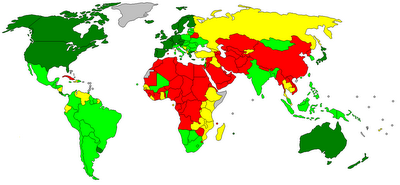
Some similarities, some differences. Nevertheless, one can see that, as mentioned above, Latin America, Eastern Europe, Southern (and parts of Western) Africa, and parts of East Asia are seeing some political gains. Much of the rest of the world is not, or is in some sort of quasi-authoritarian limbo (but much less of it ruled by military regimes or one party states than before 1991). And, despite all the best efforts of its populace and leaders to the contrary, North America, Western Europe, Japan and Australasia still rank at the top of the list. As they say, democracy is the worst form of government, except for all the others. Maybe that is the scariest lesson!
Perhaps one of the more interesting and relevant reports to come out this week has been the 2007 update of "Freedom in the World", released annually by the think-tank Freedomhouse. They have been gathering information on political and civil freedoms across the world since 1972. The following is a self-made map cataloguing the status of freedom this year (Green covers the "Free" states, Yellow "Partly Free" and Red "Not Free").
 A major theme this year is how the number of countries in each status has remained approximately the same in the past 15 years or so (although the number of free countries is much higher than, say, in 1981, largely owing to political developments in Eastern Europe, Latin America, Southern Africa and East Asia).
You can check out the report for an explanation of their methodology and scores. Their compiled comparative data can be seen here. I confess that playing with this information was a passtime of mine in whiling away the long hours in Peace Corps.
It is interesting to compare the scores with the Economist Intelligence Unit's new Democracy Index Survey. Their ratings of countries is a bit more graded, and as a result a great deal fewer countries get to stand next to Sweden and FInland near the top. Here is a self-made map of their results (Dark green for Full Democracy, Light Green for Flawed Democracy, Yellow for Hybrid Regime and Red for Authoritarian Regime).

Some similarities, some differences. Nevertheless, one can see that, as mentioned above, Latin America, Eastern Europe, Southern (and parts of Western) Africa, and parts of East Asia are seeing some political gains. Much of the rest of the world is not, or is in some sort of quasi-authoritarian limbo (but much less of it ruled by military regimes or one party states than before 1991). And, despite all the best efforts of its populace and leaders to the contrary, North America, Western Europe, Japan and Australasia still rank at the top of the list. As they say, democracy is the worst form of government, except for all the others. Maybe that is the scariest lesson!
15 Jan 2007
Rule of Law in Iraq
I was hoping to avoid comment on the issue of Saddam's execution, as it occured over the holidays when I was absent from this blog, but the bizarre executions of Barzan Ibrahim and Awad Hamed al-Bandar, two of Saddam's aides and relatives, brings me to comment.
The Iraqi government apparently released footage today showing the execution by hanging, resulting in the decapitation of Barzan. I cannot say I am an expert on human anatomy, nor on execution, but I find this a rather unusual and ghastly event.
It is, in a larger sense, a sort of microcosm surrounding the whole trial and execution of Saddam and the top leaders in his regime. Granted, they were bloodthirsty and brutal rulers whose rise to power resulted in the deaths of tens of thousands and the torture or rape of a goodly number more. But both Saddam and his aides were tried and executed for the killing of some 148 Shias
in 1982. The Iraqi courts have even gone to far as to drop all charges against Saddam posthumously for his role in the 1988 Anfal campaign against the Kurds, which resulted in ethnic cleansing, gassing of civilian populations and arguable genocide. Furthermore, the details of Saddam's execution (that the Iraqi government sought to suppress) show that it resembled something more of a lynching, with Saddam being the one showing fortitude while he is taunted and the names of Shia firebrand Moqtada al-Sadr and his father are chanted by the entirely Shia audience. These latest executions seem to also have at best a tinge of incompetence, at worst a feeling of Shia revenge in a style of Mesopotamian justice that seems little far removed from Hammurabi and the Assyrian Empire.
Saddam and his top circle are clearly guilty of war crimes and crimes against humanity. It must also be said that at the very least some semblance of an impartial court was attempted in their trial. However, quite frankly at the end of the day these figures have not been held accountable for their most heinous misdeeds, and their killings promise something more of martyrdom and sectarian violence. One wonders if a greater punishment would have been to leave Saddam, abandoned by his wife and with his sons dead, sitting in a cell, far from the centres of power and the palaces he once enjoyed. The trial and execution also seem like a duck of responsibility on the part of the Americans, who (regardless of political affiliation) say that this justice "is the business of the Iraqis", and yet also say in almost the same breath that the Iraqis are doing a good job of murdering each other in civil war.
All in all, these executions show to me that perhaps Saddam was not so unusual after all. It seems to be Mesopotamian tradition to dispatch of one's enemies in as gruesome a method as possible. So much for the hope of a new dawn in Iraqi political tradition.
France a la Anglais? Non!
I found this article on the BBC amusing. Apparently historical documents have come to light showing that in 1956 then-French Prime Minister Guy Mollet proposed to his British counterparts some form of "union" with Great Britain. His second proposal was that if a union was unacceptable, then France would join the British Commonwealth (which meant accepting Queen Elizabeth II as the titular head of that body).
The idea apparently went nowhere, but French pundits and historians are apparently tripping over themselves to denounce Mollet and state that were he alive today and he proposed such a plan, he would be tried for treason. It is too bad that the French political elite have such a hatred towards Great Britain and any thought of unity with them - they seem to have accepted Mollet's third-best plan of a European community centred on partnership with Germany rather well. This is despite the shared history and - yes - culture and language between France and Britain. I suppose the Hundred Years War still leaves a bad taste in the collective mouth of the French establishment.
In my opinion a French - British union would be in many ways a natural and strong partnership...but there would be huge political obstacles to overcome. The French approach to the state has gone in a much different direction from the English since, well, since the Hundred Years War.
Subscribe to:
Posts (Atom)

