12 Dec 2006

Some (Further) Oppression in Kazakhstan


I must admit that I am not a terribly great fan of Hare Krishna adherents, but I view them much as Douglas Adams' Hitchhiker's Guide to the Galaxy rates Earth: Mostly Harmless. I do remember them being a visible community in Almaty, but they certainly never got in anyone's way.

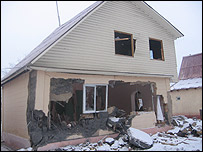
Therefore I find it somewhat shocking to read this latest news of a literal attack and destruction on a Hare Krishna community by local authorities in Kazakhstan. As this article points out, this heinous action seems to belie the Nazarbayev regime's claim that it is a religiously tolerant and diverse nation. Apparently some religions are to be better tolerated than others.

It reminds me very much of a sad discussion I had with a Kazakh student two years ago, upon my first arriving in my city where I worked. This woman was an ethnic Kazakh, with a very good command of English and who has since become a teacher in that town. We were talking about religion, and she stated that she considered herself non-religious, and that Kazakhstan should be tolerant of many religions. But she then followed this statement with a strong condemnation of the city of Uralsk, not far from us. The reason? Uralsk has a Russian Orthodox church in its city center, and Kazakhstan is supposed to be the nation of Kazakhs, and Kazakhs must be Muslim. Despite my protestations, she apparently did not get the complete contradiction in her viewpoints. And this was a member of the educated youth!

I am not trying to slam the people of Kazakhstan. Probably all nations grapple with issues of religious freedom. Nor, to press the point home again, will I say that I am a great friend of those who seek to publicly push their religion on others, especially through missionary activity (and, although I am probably by their own definition no longer Catholic, I still take some comfort that my religion of origin has turned from pure missionary work to social justice programs and inculturation). To be honest, one wonders how much politics have to do with this act. Pentecostal missionaries are much more widespread - and obnoxious - than Hare Krishnas, but undoubtedly Kazakhstani authorities realize that an attack on them would mobilize religious zealots not least in the United States.

However, at the end of the day, it is not the business of a government to act more violent and obnoxious than this religious groups. If the groups are behaving peacefully, and not attempting to undermine the society that they live in, then the state should allow them to openly live their lives and speak their piece. Debate and cohabitation is the best possible test for the rest of us and our beliefs.

The rightness or wrongness (on a religious level) of their acts is not for political authorities to decide or to punish. And this oppression does not just extend to persecution, but to legal restrictions on the voicing of religious opinions. Kazakhstan, much like other countries in the Middle East and its environs, places strong restrictions on any political organizations advocating a religious or ethnocentric point of view. While this may seem necessary for cohesion in a young and fragile state, the suppression of any such sentiments will only make them come back in worse versions (just ask Algeria and Egypt). The government of Kazakhstan would do well to stop meddling one way or another with religion and with Hindu converts and get about their sorely-neglected business of attempting to improve their people's lives.

11 Dec 2006

Another 20th Century Figure Passes from the Scene

Whatever your opinion of Augusto Pinochet, it must be admitted that the nation of Chile, and perhaps the world, has turned a small historical corner with his passing at the age of 91. As the Economist relates, even those on the political spectrum inclined to agree with Pinochet and to appreciate his policies had come to see the General as something of an anachronism.

This appears to be a new problem of our age. With ever better health care and ever better scientific understanding, lifespans have increased dramatically. This has meant that a large number of world leaders (mostly from the World War II and post War generations) have remained on the scene long after their careers had either formally or effectively ended. Think of Ariel Sharon, Yasir Arafat, Ronald Reagan, King Fahd of Saudi Arabia, Zayed bin Sultan Al Nahyan of the United Arab Emirates, and these deaths have all been in the past couple years. Fidel Castro is also fading from the scene (with his slightly younger brother Raul waiting in the wings).

Old leaders from a previous era seem to have a habit of hanging around longer than, perhaps, for the good of any. Italian politics is especially noted for its gerontocracy. When one starts playing hisotrical games, however, one begins to wonder if history is slowing down these days, despite all the claims of the world speeding up. One often hears the lament that World War II vets are dying out every day, but who was lamenting the demise of Mexican War veterans in Theodore Roosevelt's years? John Kerry's and George W. Bush's Vietnam records were hotly debated in the 2004 election, but a century ago Civil War veterans had already faded from the Presidency (McKinley was an enlisted man, and the last Civil War officer-turned-President was Benjamin Harrison). Theodore Roosevelt and Woodrow Wilson were children in the 1860's, but where are the Presidential contenders today who were mere children in the 1960's (I know Barack Obama meets these age requirements, but I am wondering where the more heavy hitting statesman of such an age are).

Granted, our lifespans have increased, but has our wait to a mature age also increased? Our lives seem faster these days, and our politics seem influenced by minute-by-minute changes on 24 hour news channels. Yet we still debate the 1960's and Vietnam, and glorify the living veterans of a war that ended almost 2/3 of a century ago. We seem to forget so much of our history, but at the same time it seems like we have trouble letting our history go.

With the passing of Pinochet in Chile, it seems that hopefully everyone in that country can be relieved that more than a little of their history has left them.

Energy Efficiient?


Today was bill-paying day for me, which is an unpleasant yet necessary act for all of us without capital liquidity. In any case, I was on the NStar website paying my electricity bill, and I found this little nifty graph, displaying the energy consumption in my apartment over the past year. We moved into our place in September, and from what I gather the apartment was more or less vacant over the summer for renovations. You can see an obvious difference in the electricity consumption before the summer and after September, almost by a factor of three!!!

Considering that this is the same base apartment, with presumeably the same number of people and the same appliances (which from what I can tell are not rated as anything specifically energy-efficient), this seems like an interesting experiment. What on Earth were these people doing that their energy consumption was three times as high? We watch television, use the computer and cook and wash our clothes. But we turn things off when we do not use them. Maybe someone can explain just how we manage to be more energy efficient than the average American, and why more people cannot achieve this.

10 Dec 2006

Another Grand Design

My recent posts seem to have focused on the grandiose, dare I say baroque and extravagant, plans of world leaders. This latest one comes from my adopted second home, Kazakhstan. President Nursultan Nazabayev has decided to build a domed city in his pet project, the capital city Astana. Ironically, this is an idea that I had proposed to people during my time there (perhaps under an inebriated state). The climate of Astana faces 80 degree C swings over the course of the average year, and so I had thought that if possible one might as well just dome the entire capital. Apparently the Kazakhstani President will settle for a luxury neighborhood.

However, this idea, I must point out, is purely a stupid one. While building model cities is all well and good, at its very heart Astana is a Stalinist dream. The difference between it and Dubai is that Dubai actually accords some space to efficiently-run private business (Emirates Airlines and Dubai World come to mind), while Astana is President Nazarbayev's personal whim financed by state oil revenues dished out to contracters in a very post-Soviet fashion of corruption. Furthermore, the President believes that he can bully and cajole foreigners and locals alike into making his dream a reality, ie that Astana will be the "true" center of Kazakhstan, ie the national capital, largest city and business center ("not like Canberra", Nazarbayev's advisers have stated). This strategy has extended into even the attempt last year to force international airlines to fly into Astana rather than Kazakhstan's actual largest city, Almaty.

Like the steppe empires of Attila and Chingis Khan before him, I believe that this city of Nazabayev's, with all of its wonders, is nothing more than a modern Xanadu, that will vanish with his passing from power. Meanwhile, despite - or perhaps because of - all this oil wealth, Kazakhstan's teachers and doctors are among the nation's lowest paid professionals. Recently scores of children in the southern city of Shymkent were infected with HIV by incompetent healthcare providers. The education system is a disaster, lacking even a proper grading system (the Soviet grading system of 2,3,4,5 remains, but no one receives 2's - the worst - and bribes are paid for 4's and 5's). The cities of Kazakhstan are filled with banks and casinos, but few independent businesses, indicating to me that there is a lot of money sloshing around this economy but with no real purpose. Better to invest this money in strengthening Kazakhstan's future potential economy than to waste it on such unnecessary luxuries.

5 Dec 2006

Lunar Plans

No sooner do I write about the building of British nuclear weapons as a wasteful prestige project, then news comes from NASA of their firmed-up plans to build a moonbase by 2020. This seems to more or less follow the plan for a permanent presence on the Moon and manned exploration to Maras as laid down by President Bush in his "vision" speech of 2004. No cost has been stated, but expect something in the tens of billions.

I will state my reservations about such an enterprise. This project will be costly, and of dubious scientific value. Further, the expenditure of such funds will likely stifle the attention needed by more useful yet small-scale projects. A government-agency mission to the moon seems overly inefficient and old-fashioned, and raises potential fears of the weaponization of space.

Yet when all is said and done, I would still rather oppose this project and see it go ahead anyway. At some point humanity must begin to explore and inhabit its solar system on something of a more permanent basis. The fact that to date no human has left the immediate orbit of earth for anything more than a few hours, despite the thousands of pages written and thousands of hours filmed on the subject (both fiction and non-fiction) indicates to me that a permanent settlement on the moon in itself would possess some scientific value. Just how will the human body adapt to life on another heavenly sphere? Surely a moonbase has more lasting value to science and humanity (by capturing the imagination and providing facilities for experiments as yet unplanned) than the obsolete International Space Station and space shuttles, two super-expensive Cold War relics.

I say good job to NASA for finally scrapping the shuttle with plans for a new bold step forward. And I wish even more luck to Virgin Galactic. Carl Sagan once stated that he considered the hybrid government-private business model of the Dutch and English East Indies Companies to be the prime means to further space exploration. I cannot urge the greater participation of business in space travel more strongly.

A Modern Pharaoh and his Pyramids?

Although he may be ideologically closer to Clinton, Tony Blair has shown himself to be a true soulmate of George W. Bush in a number of ways, one being his governmental tendency to throw good money after bad. His latest demonstration of this has been his latest proposal to spend 20 billion pounds (at the current moment something in the range of $40,000,000,000) to upgrade Britain's ageing nuclear deterrent. This money will go to building a new class of ICBM-armed submarines to replace the Trident system in about 17 years' time. The system is deemed necessary owing to such threats to nuclear nonproliferation as the North Korean atomic programme (in a poverty-stricken country whose ballistic missiles, if not exploding on launch, could currently barely reach Alaska), and the potential for state-sponsored nuclear terrorism (a fear whose basis in reality some specialists are beginning to question). Apparently money spent on such prestige projects is a better line of defense than money spent on conventional forces (Britain's are already stretched to the limit, as its top officers are stating) or better intelligence.

But what is ironic is how questionable the use for a nuclear-armed Britain has ever been. As a member of NATO, the UK has been under the American nuclear umbrella for over 50 years. Even during that time, a country with something like 2% of the world's population faced guaranteed nuclear annihilation at the hands of the Soviet Union (with over four times the population and many more times the area), and could at best incinerate a handful of Soviet cities. Since the Cold War the very need for a nuclear umbrella struggles to be proven.

Yet much like the American Anti-Ballistic Missile defence system, such anachronisms continue to be built. In my opinion the singular failure of Donald Rumsfeld was his inability to hold to his promise to end Cold War-era money pit projects and streamline and modernise the American military. Blair seems to have taken note of Rumsfeld's failure. As some MPs have pointed out, this very proposal is being rushed, perhaps in an attempt to build a nuclear Blair legacy.

Whatever the value of nuclear weapons, it seems redundant for such a country as the United Kingdom to spend billions on their maintenance and updating. Blair has shown some political courage in attempting to address unorthodox yet pressing problems of our time, such as Global Warming, the Palestinian-Israeli conflict and societal collapse in Africa. It is a shame that as his time draws to an end, he too has decided to throw some military pork into the works in the name of a political legacy.

27 Nov 2006

Another Movie Review

Not so many years ago I had a dislike ofBrad Pitt. It was one of those irrational dislikes. I considered him a bad actor in bad movies. However, after I began to view his films the "exceptions" (Interview with a Vampire, Se7en, Fight Club, Snatch, 12 Monkeys) began to be the rule. Now I will not hesitate to say that he is generally a good actor in good movies.

I have come to the reverse conclusion about Nicolas Cage. For some reason I always gave him the benefit of a doubt, but especially after seeing such garbage as Wicker Man I realise that he is generally a terrible actor in terrible films. This newfound opinion of mine has been justified by my recent viewing of Lord of War.

Although that last film came out a year ago, I wish to review it, as it connects to international politics and other topics often addressed in this blog. This film was produced by and stars Cage, and was directed by Andrew Niccols of Gattaca. It is a film purportedly "based on actual events" that follows the life of Yuri Orlov, a Ukrainian immigrant to America who enters the international small arms trade. Long and short, he gets into the business with his brother, they prosper (most notably in the former USSR and Liberia) despite the dubious morality of their business, and then the dream falls apart with Yuri losing almost everything (including his family) before being bailed out by the US government to continue their dirty business. This is a movie with a moral to tell, and a strong agenda.

And in my opinion, it's absolute garbage. It fails to make a convincing sell: is it supposed to be a factual account? If so, then why does it take such egregious liberties with reality? The most outstanding of such errors involve such things as Interpol. Ethan Hawke plays an Interpol agent who is Cage's nemesis, pursuing him and attempting to bring him to justice. First of all, small arms dealing is hardly a criminal offence, but to push home the fact that the director thinks it is, we see an Interpol armed with the powers of search, seizure and arrest, not to mention warships and jet fighters!!!!! And silly me for thinking it was a database and information-sharing program. Apparently the audience is to believe that our hope and salvation relies on some sort of World Police to protect us from such horrors as arms trafficking. Further, large liberties are taken with Liberian history, geography, and reality. Why even mention the country if it is to be given a fictitious president, complete with a rapper-wannabe son and a Monrovia so rundown that even Cage's character, a guest and friend of the president, stays in a two-star prostitute-infested roach motel? Surely this has more to do with Americans' perceptions of Africa more than anything else, but more on that later.

Besides not being sure whether the film is fact or fiction, it is not sure whether to be a drama or a documentary. We are forced to sit through the pointlessness of Cage's character's family struggles, namely with the screwup younger brother with the heart of gold, and the beautiful wife who (somehow) doesn't know Yuri's true business and whose parents were killed in a violent crime with an illegally-purchased gun (liberals, high five!). Yet at the same time Cage narrates the entire film with lots of "did you know" facts that bore us and don't weave together a bigger picture (and the last shot's statement that the five biggest arms sellers are the five UN Security Council members is flat-out wrong, but presumeably numbers five and six, Germany and Canada, are too ideologically close to Hollywood to merit finger-pointing).

But finally, I disliked the film's message. The movie basically goes beyond a simple "guns are bad" and reaches a Michael Moore-ish "the American military industrial complex makes wars to sell guns and kill people". Hawke's character even goes on a tiresome rant about how even detaining Cage for one day will save countless lives in Africa, because of course Africans do not fight wars with each other unless white people tell them to, and are unable to acquire guns or other weapons from other sources (the movie never points out that the AK-47 has been officially copied and produced in 11 developing countries, and unofficially produced in many more). The film takes a very patronizing attitude towards Africa and the developing world: those people are beasts when armed, and its up to the enlightened members of the developed world to keep capitalists from manipulating these otherwise innocent children for evil.

There are other pointless political jabs - Cage's literally shadowy guardian angel is a Col. Oliver Southern (har har), and the otherwise admirable Ian Holm (Bilbo Baggins) wastes a role by being an arms trader different from Cage because he"chooses sides" and cares about outcomes - without ever explaining what this means, much unlike a similar but better debate in Spy Games (there is Brad Pitt again), and is promptly shot in the head. During a brief respite, when Yuri goes legitimate selling African timber and minerals, he makes a dig about being able to "legally exploit developing countries". Likewise, there's something about Cage doing drugs and having unprotected sex with prostitutes in Africa that is obviously supposed to lead to him contracting HIV, but apparently the director forgot to film that last scene.

Long and short, this film tries to do everything, and falls far flat. The strongest attempt at a moral decision it takes is when Yuri's wife calls for him to quit his work. Yuri responds "but someone will just fill my place anyway", to which his wife's response is "yes but you won't be doing it". So if we can't save the world, we should just wash our hands of it? That sounds like a message hearkening on left-leaning European international relations! This film draws on stereotypes and cliches, as well as pure unrealities (the Sierra Leonian RUF apparently operates in the desert, and has all its intended victims kept in a refugee camp right next to the purchase point for the machine guns to kill them with - how convenient! too bad the RUF operated in a jungle and used machetes in real life...) in order to make America feel guilty for being evil. And admittedly, most of today's weapons come from North America. But this is the real world, and arms sales is a real business (and is often in the realm of international relations and not at all being as clearly an evil as this movie would have us believe), and as even Cage points out, if we don't arm these militaries, it is not like someone else will.

26 Nov 2006

A Modest Proposal

This is just me thinking out loud on this one...

On Friday I had the dubious honor of dropping my wife off at her sales job...at five in the morning. Her place of work was already swarming with eager shoppers, and was such a notable event that the television camera crews were already filming it for the evening news. Thus began "Black Friday", the day of frenzied shopping resembling ever so much a school of sharks around fresh meat. Economic sources indicate that this day of mayhem is likely to be matched in sales on "Cyber Monday" (when apparently millions of slackers use their companies' internet connections to purchase Christmas presents) and the last Saturday before Christmas (which is generally when slackers like me - men? - go shopping).

All this leads me to wonder: are people overdoing this Christmas (sorry, Holiday) shopping/giftgiving thing? I wonder because the fact that everyone does it at the same time makes me feel like ultimately it is a meaningless gesture. Everyone gets so many purchased presents from everyone else that they know that I think it's lost all point. I long ago stopped telling people "what I want for Christmas".

Here is my modest proposal: people should get back to enjoying Christmas, or whichever other Solstice-themed religious holiday will stand in. Feast and be merry. If you want to give people presents, give your family and friends gifts in January or February, which is the bleaker, more un-festive part of winter that needs some cheer. And the after-Christmas sales of surplus mean that the shopping will be cheaper. Or you could *gasp* make something special for your loved ones, rather than purchase various goods made in factories in China as a means to symbolize your love and generousity. Of course, some people would be offended that you are not giving them presents specifically ON Christmas, but if so those people obviously aren't that close to you and do not deserve presents anyway.

I would like to put this modest proposal into practice, but something tells me I will give in to the herd mentality, like everyone else.

25 Nov 2006

Congressional "Draft Picks"

It is something of old stale news in the blogosphere, but I thought I would comment on Representative Charles Rangel's motion to reinstate the draft. This motion is interesting as it in some ways acts as a microcosm on the debates and politics of the day.

First of all, as blogger-journalist Howard Kurtz notes, this motion and the speed with which other Democratic congressional leaders have distanced themselves from it is somewhat indicative of the larger lack of direction or unity among Democrats. The fact that any such motion would be soundly voted down by members of both parties also points to how much reinstating a military draft would be like voting on Social Security. Another interesting relfection on modern politics is how, from what I can gather, Rangel's draft motion is not really a serious idea anyway, but either some attempt at political showmanship or some vague poetic justice That Congressmen wouldn't vote for wars if their children had to serve, although a.) this did not stop them from approving World War II and Vietnam and b.) it's a bit of an open question how many Congressmen have draft-age children anyway, and ignores that draft or no draft being a Congressman's son or daughter means you're never going to a foxhole unless you want to.

That fellow Democrat Rahm Emanuel has countered with a plan for compulsory national service (whether in the military or some - mandatory?- volunteer duties) shows that this debate is more about some sense of "values" and might lead to a political compromise similar to Germany's conscription: one year of compulsory military service that can be earned in volunteer charity work. I met a German student once who fulfilled this requirement by working in a nursing home. Should I point out that Germany has a large problem even mounting peacekeeping operations? Such "national service" seems like a bigger waste of time and energy than just a straightforward military draft.

Kurtz's survery of internet opinion also shows that the draft is a concept now completely foreign to large portions of American society. Some decry it as two years of slavery, a writer from the National Review opposes it on the notion that the volunteer army does not need it. All, bloggers, journalists and politicians, overlook the fact that the United States technically does have a draft, called the Selective Service that is there to be mobilized after the full-time units, individual and unit reserves and National Guard have been mobilized. But, let's be honest, Selective Service is something of a joke at best, and will never seriously contribute to military command. Also, in theory, is the US military supposed to be manned and equipped to fight two medium conventional wars at once, but this also seems to be something of pie in the sky. So much for objectives, and the political will to meet those objectives without meddling in micromanaging the details.

Jim Webb, Senator-elect from Virginia, wrote an article on why reinstating the draft would be a good idea. It can be found freely viewable here, and I should point out it was written in 1980, before he was even Secretary of the Navy. If he still believes half of the things he writes here (such as women being unfit for combat duty, the silliness of a volunteer army's advertising and "seducing" of potential volunteers, the ease that volunteers can quit and the downright necessity for strengthening military discipline), then he cannot be too popular with Nancy Pelosi or Howard Dean. But nevertheless his views seem even more relevant today, and it is a hopeful thought that he could sway more people from his party. Perhaps the military does not need a draft, but Webb seems right that American society could use one.

I sincerely hope that we will have more political leaders like Webb and like McCain (who broke political protocol by stating things like they are - that troops levels need to be raised in Iraq before anything else, as requested by Gen. Abizaid among others). These Navy vet senators seem to have a better grasp on ideas and the relative importance of what needs to be done.

23 Nov 2006

Influential Americans

No magazine, it seems, can resist putting out a "greatest 100" list. You might remember an excess of these from the build-up to the year 2000 (how long ago that seems!).

In any case, the Atlantic Monthly has put out its own 100 list, and admits openly that it is an attempt to work up historical discussion more than anything else. They polled noted American historians on who has had the greatest influence or impact on American history, and the top 100 figures (ie, those receiving the most votes) are included on the list here. The list can be viewed without a login and password, and the analysis here (which requires a login...you can ask me for it).

The editors note that the list is interesting in that it is very traditional: Founding Fathers, Captains of Industry and Great Inventors rank high, and the overwhelming majority of figures are native-born Northeastern men of European ancestry involved in law or politics. Also, there is a lack of collaborators in favor of singular figures. There are, of course, exceptions to these tendencies (eg. Martin Luther King at 8, Susan B. Anthony and Rachel Carson at 38 and 39). A prejudice is made against the contemporary, for who knows how their achievements will stand over time, as well as those who are popular or are celebrities (fame is fleeting). A bias is made in favor of the fundamental and those who have the widest impact (as opposed to being on the list to just represent a special interest). But still, the argument is raised: is Walt Disney really that important? Have no American Indians influenced American history? The article points out that the list gets more interesting after the first 100, where such figures appear as George Lucas, Julia Child, Nikola Tesla and Willis Carrier, inventor of the air-conditioner, without which the Southern half of the United States would be an underpopulated, hot and humid backwater.

An interesting and worthy topic for debate, in any case. Feel free to read the list and use it for conversation topics this Thanksgiving weekend.

20 Nov 2006

While I've Been Away...

I was once told by a professor of mine that people who leave their home country for two years never quite fit in again in their home country. They can be natives who have followed domestic happenings while they were abroad, but there will always be the little things that they just do not get.

Well, I was away from the US for two and a half years, and have only been back for five months or so. Besides the face-on culture shock of moving back to America (I still often feel like an immigrant), there are myriad things that I just "don't get". Here is a Top Ten List (a la David Letterman...if he even still does this...)

10. Christmas now begins before Halloween. Need I say more?

09. Hats. I remember back in school, if you wore a baseball cap, the rim needed to be broken in to be "cool". Then people began wearing baseball hats backwards. Then sideways. Now the cap must be worn facing frontwards, but on an off-angle of about 45 degrees. And the rim should be cardboard-straight. I and some other volunteers first noticed this one running into student travellers in Thailand, and we knew American culture had begun to pass us by. Where did this one come from?

08. Elastic bands are now a fashion item to be worn on the wrist. I have seen this one, and I really do not understand it at all.

07. Television. It is even worse than it used to be. And I just am not even bothering to get back into the loop. What the hell is "Lost"? Its like a scripted Survivor or something? Whatever...

06. Pop-tarts. All of 'em. How is Britney Spears still popular? I know a lot of it is morbid curiousity, but still, she's younger than me and already looks 15 years older than she is. Granted she had two kids, but she's also a millionaire. And just why do people pay attention to Paris Hilton????

05. Internet society. Yes, I am being a little hypocritical as I am writing on a blog, but still. I see many younger coworkers of mine writing on Facebook and MySpace and YouTube and whatever other combined-word-name websites are out there. And I don't get it.

04. Organic food is now everywhere, and it basically just means its the same old food but at more expensive prices. There do seem to be a lot more farmers' markets, and that is the one good unknown that I've encountered on my return to the States.

03. iPods. I know that people had them in 2004 before I left, but really, it has become a new staple good. I guess its better than people playing their cellphone ringtones for entertainment, as is common in Asia. But still, what is up with people's newfound worship of Apple?

02. Another fashion unknown to me: Men's hairstyles. What is with guys styling cowlicks into their hair? You know what I mean: the hair sticking up on the front of men's heads. It seems like this is the new power-cut for men, the more "relaxed" style being the 70's-esque jock overgrown mop. Someone just needs to call in the Paris Island barbers, please...

01. Politics. No, even though I keep up on it, American politics still baffles me. Why are people now all of a sudden tired of Iraq? What makes it more of a disaster now than in 2003-2004 (granted its not much better, but to be fair it's not that much worse). I said it before, I'll say it again: if Americans are tired of the war now, then they shouldn't have supported it in 2002-2003 and then reelected Bush. You made your international obligations, deal with them. I find it insane that the political world has pulled a complete reverse: Thomas Friedman and Fareed Zakaria, who supported Bush and introducing democracy into Iraq now say its a bad idea that won't get anywhere, and Paul Krugman who once so decried the future bankruptcy of Social Security wrote vehemently in 2005 about the lack of a need to reform it. Apparently people went from being gung-ho pro-Bush in 2001-04 to being anti-Bush since then. Where does this all come from? And speaking of politics and society, why does it seem now that everyone in America either speaks Spanish or hates people who speak Spanish?


Number one wasn't much of a Letterman punchline, so here we go: Boston Teams have won championships in their respective leagues. Wow.

13 Nov 2006

More Sage Words from a Celebrity

I will admit, that I have heard a lot of advice from celebrities on weighty subjects over the years: from Britney Spears and the Dixie Chicks on the Iraq War to Madonna on international adoption and K.I.S.S. on the feasability of a two-state solution in the Israel-Palestine conflict.

Now, Elton John ... excuse me, SIR Elton John ... has spoken out in order to set us straight (no pun intended). He states that organized religion needs to be abolished. While I do admit that organized religion has caused quite a great deal of unnecessary quarelling and conflict over the centuries, I'm not sure that it has exactly created a world of "hateful lemmings" (something of a bizarre metaphor). Nor do I quite understand how he makes the leap in attributing anti-gay sentiment in Latvia, Russia and Poland (until 1991 all officially atheist countries) to organized religion. Nor, quite frankly, do I really understand what organized religion has to do with anti-gay sentiment at all (you will find that different members of different religions take a wide variety of stances on the subject...and therefore Sir Elton is including in his condemnation such gay-friendly religions as Buddhism in Thailand).

Nor do I understand how he can combine this statement with other statements praising Jesus and Sunday school (the latter mostly for its stickers) and religious gays. Nor how he can call for a worldwide religious conclave (in my opinion the best idea from this muddled tirade, and reminiscent of something from Dune) by the religions he wants to ban.

Nor, to be honest, can I remember just why this man is famous in the first place. Something about singing...

12 Nov 2006

Lest We Forget

Today is Veteran's Day. We should remember the veterans of all our conflicts today. If you don't mind acting like Canadians, Brits or Australians, wear a poppy flower in memoriam.

It is interesting that in the former Soviet Union veterans are honored on Victory Day, the day marking the fall of Nazi Germany in World War II. By contrast, the West remembers its Veterans today (and in America, confusingly, also on Memorial Day, although I am not too clear whether it is specifically veterans killed in combat who are remembered on May 28, or all deceased vets, or just all deceased). Today is the 88th anniversary of the cease-fire that ultimately ended the First World War, and that led to the Versailles Treaties. It was the unwillingness of the Western Powers to uphold these treaties and to occupy and disarm Germany, as well as the fiction generated today that the German military was unbeaten and had been betrayed by Jewish-led Socialists and Communists, that ultimately led to the far more destructive (and better-remembered) Second World War. So today, a day that has become something of a forgotten holiday, should be a day to remember that any conflict can be a lost cause if we lose the political will to properly resolve them. Such conflicts will not disappear, however. They will come back to us, often in a more horrible guise.

11 Nov 2006

Tis the Season?

I work in an office above the Copley Mall in Boston, and the mall has already been decorated with garlands, wreaths and sales advertisements in anticipation of Christmas. Christmas is still almost two months away! This holiday season, at least in its commercial form, keeps getting longer and longer. I will refer the reader of this blog to my rant concerning Halloween for my thoughts on the subject.

Yes, I should point out that my feeling that the Republicans would pull off a last minute rebound in the elections was wrong. But, as the Economist pointed out, if you bet against yourself then no matter what happens you can feel good. So, yes I was wrong. Thank God! Also, Tim's endorsed candidate for the Senate in Virginia, former Secretary of the Navy Jim Webb (D), beat the presidential hopeful George Allen (R), in the tie-breaking seat for Senate control. Thats two for the price of one. Hopefully the victory for such Democratic moderates as Tester and Webb in the Senate bodes well for American politics. I am a little hopeful, even though I am sure American politics is going to get a lot hotter and nastier over the next two years. McCain should still be the eventual Presidential winner in 2008. That's my endorsement.

Anyway, it looks like Madison can rest easy knowing that the American system is righting itself (no pun intended) a little. And we have a potential female Speaker of the House, which is a nice advancement (whatever her politics may be). And George Bush is immediately acting smarter, which is also a welcome change. Things are looking a little better these days.

7 Nov 2006

Elections, elections...

I know everybody and his brother is blogging something on the upcoming US elections. Why, the BBC alone has a team of bloggers chugging away on the topic! And them's furriners! Something comes to mind with Shakespeare, monkeys, typewriters and infinite time...

Still, I wanted to make at least one statement. Perhaps it will not mean much, perhaps it will look foolish, perhaps prescient. However, I wanted to use the opportunity, Election Day -1, to state that I have a feeling that 2006 will not be the political sea-change that the media would like to make it out to be. I have a respect for the genius of Karl Rove, and I have a strong feeling that the Republicans will do much better tomorrow that one might think. Will this mean that they will retain all their political spoils? Doubtful. However, I can see them making it as difficult as possible for any races to be settled against their interests. I can even see them keeping control of the House, or even better/worse (depending on your political persuasion) giving up control, but only enough to make the Democrats look more incompetent.

However, ultimately nothing will change, at least not this time. I must admit, that one reason I grow tired of politics (as opposed to policy) is because one senses that it is all the more a hewing to the status quo, an inadventurousness and a true fear for change. I am sure politicians have always been so, but then that was why there were statesmen above them. Now, however, even such allegedly venerable offices as senator and president are mere political hacks in a 24/7 popularity contest, and the closest thing to statesmen (like, believe it or not, Dick Cheney), are shadowy figures. To paraphrase Churchill, politics has gone to the modest men who have much to be modest about. (This was spoken about Clement Attlee, and the statement itself is a misleading political quip, as history showed Attlee to be a better statesman than his contemporary political rival allowed).

It is interesting in other respects how so little changes in politics. Nicaragua went to the ballot boxes yesterday to vote for a new president, and the likely winner (thanks to some jimmying of electoral laws) looks to be former Sandinista Daniel Ortega. The State Department has engaged in some undue meddling, stating their disproval over the possible presidency of this former foe. However, Mr. Ortega seems to have gone far from Marxism (what with there being no Soviet Union and a geriatric regime in Cuba these days) and is more of a populist than a threat to strategic balances of power. His very existence and political survival, in my mind, is a perfect example of how conflicts arise as a result of rivalries between Great Powers than from anything else, democracy, the UN, or whatever. There will be no new contra war, I think we can rest assured, although the US risks looking a little foolish not letting go of Cold War ghosts. And I will not even begin on Oliver North's campaigning against Ortega...perhaps a little jealous that this former foe of his has found a better career than part-time conservative politician and commentator on Fox News?


So, go vote (the city Somerville reneged on their promise to mail me directions to the nearest polling station!), and then get on with your life, because things will be as they have pretty much always been. It's amazing how much money gets spent on these campaigns, when ultimately very little changes.

1 Nov 2006

Speaking of our cheap modern culture...

What is the deal with modern horror movies? I don't want to sound like an old man, but I just don't get the point any more. I once read that the difference between terror and horror in films and literature is like the difference between erotica and pornography. The concepts of terror and erotica in culture attempt to titillate the mind by suggestion and a certain level of craft, while horror and porn are blunt, brutal, and just try to supply the consumer with an animalistic fix.

The level of gore and violence in films is in general not something I disapprove of, or more properly care about: I am not some Tipper Gore trying to mandate what people should and should not see. I do not think it corrupts our culture, but more accurately the reverse: it sells because our culture demands it.

But I ask myself, and this is where I get really baffled: how can large numbers of (allegedly) adult citizens watch a film whose plot is basically that a bunch of people get cruelly tortured and killed? And this is the third installment in an incredibly popular series!!! To me, this doesn't seem like playing on our sense of fear as much as raising bloodlust in the brutal and increasing depression in the thinking. Either way, it seems to be somewhat mindnumbing. My passions even get more aroused when I think that the audiences for whom such films are made are alleged members of the Western civilization that finds the Holocaust and terrorism to be acts of evil. Apparently real political violence is bad, but fake (although extremely graphic) violence for entertainment is enjoyable. It seems that we are a step closer to the Roman ampitheatres, and we know where the Romans wound up.

I would much more highly recommend The Ring, either in its original incarnation or the American remake. That is a truly terrifying film.

Le Halloween

I noticed this BBC article regarding the collapse of the Halloween fad in France. I find it very interesting, although I do somewhat doubt that Halloween's unpopularity is owing to anti-Americanism in France. The surprising lack of celebration of the Fourth of July might be more directly related, but as The Economist often points out, the French are heavy consumers of American films and fast food.

There probably are good reasons for its unpopularity, and I'm sure some of them come from the artificiality of Halloween. Halloween and St. Valentine's Day both fall into this category: they are often denounced as fake holidays made up by capitalists in order to make money. However, if the holiday products were not popular, then companies would not sell them - exactly as they are doing in France!

The ultimate problem stems from the quandry of holidays. Holidays are ultimately events based on tradition or collective experiences, and so it is rather difficult to up and introduce them into new cultures, unless related to some sort of immigration or fad. Ireland is the only country that celebrates Halloween as an actual national holiday, because the Irish have maintained their connections to the holiday's Celtic roots. The English and the Americans steadily lost this connection over time, and especially in the constant churning of American society Halloween got replaced with something easy, non-religious and "safe - fun". The trick has been banned, and the treat sweetened and sold in stores. Ultimately, it is a meaningless holiday because any meaning was intentionally stripped away. In this sense, the French are right, because the only remaining value is to a specific, targeted demographic market, much like Valentine's Day, and even Christmas. Let us not forget that the old English Yule festivals never made it to America, because of the Puritans banning such pagan celebrations, and that Christmas only came to the shores of the New World because of German immigration (bringing St. Nicholas and fir trees) and a Victorian obsession with the Gothic, the archaic, and (once again) "safe-fun" for the family.

My wife remarked to me that Americans are terrible at celebrating holidays, and I must agree with her. The American idea of celebrating a holiday mostly consists of buying peripherals and decorations, and then once the holiday arrives by sitting in front of a television at home and eating. Even the parade is an increasingly rare tradition (when was the last time you went to a parade?). And as for street festivals and carnivals? Forget it: those are for immigrants or for drunken college coeds in New Orleans. In my experience, other countries seem to celebrate with more heart: I have eaten a traditional Christmas dinner at a vicarage in England, complete with hasty pudding. I have celebrated Nauryz in Kazakhstan by going to street festivals, watching live singing and dancing and horseracing, and by eating ethnic food. And the latter country is not even a rich one! I question why Americans have so much, yet celebrate so pathetically. Perhaps O. Henry was near the mark, when in one of his short stories he noted that Americans are always attempting to create new "traditions" to make up for their lack of any.

Or these days they just try to buy them. The BBC also noted that Americans are spending five times as much on Halloween as on the 2006 political campaigns. Billions and billions for cheap costumes, beer for the adults and snickers bars for the kids.

So be frightened! Eat some candy! Vivre le Halloween!

27 Oct 2006

Another Good Documentary

Frontline has another good documentary on North Korea, a subject that I think is better left to the Cyberpanopticon's thorough forum. I will, however, say that after watching this 2005 documentary it appears to me that the current American Presidential administration has very little solid idea on how to address the North Korean nuclear problem. The administration has decided that the North Korean regime is evil, and that therefore they cannot deal with it on essentially any level. However, on the other hand they claim that the North Korean situation is not a "crisis", and that military force is not a real option. I guess this means that the President ultimately does not really care, even with the nuclear tests and that North Korea has conducted and the resultant UN sanctions since this documentary was filmed.

We will see how that policy plays out, especially considering that nuclear weapons and a possibility of regime change are only a few possible headaches on the Korean peninsula, besides conventional war, social collapse in North Korea, and the evitable concerns of a Chinese rising power.

The North Korean footage reminded me a lot of life in Central Asia. There are definite Soviet traditions shared, but at least (somewhat) greater political freedom and greater economic freedom have positively impacted Central Asia. Still, that peaceful change was fifteen years ago, and it still far from complete, nor has it brought stability to the region. American policy-makers should not expect any better, but should fear much worse, from North Korea's future.

Good Documentary Link

I have to say that one of the PBS productions that I enjoy watching is Frontline. They have very concise, informative and detailed documentaries on just about any possible subject of public interest, from Herbal Medicines to the Kennedy Assassination.

You can freely download and watch them. I just watched "The Lost Year in Iraq" (aired Oct. 17), and I have to say that it sums up a lot of my feelings and impressions on Iraq and the US policy (or lack thereof) regarding Iraq.

I would like to point out that they mention just what kind of people they put in charge of the CPA in 2003. The documentary addresses that, but one sterling quote is: "I never in my life thought I would encounter 'frat brothers' and 'strategic planning' in the same sentence."

All in all, I would say that 2003 for everyone (myself included) was a wasted year. I thoroughly enjoyed relocating to a more independent and stable developing country the following year.

22 Oct 2006

More War or Less?

Well, after reading through some of the day's latest headlines regarding the growing war in Somalia (one that seems to be much overlooked, much like most of Africa's conflicts), I have decided that it is time for me to share the links that I have been perusing off and on for the last year. I have been attempting to collect data on conflicts across the world, as I was hoping to assemble a 2005 version of the book New State of War and Peace. That plan is on hold.

2006 has been, in my un-scientific impression, a pretty rough year as far as peace goes. I would go so far as to argue that there has been a real uptick in both civil and international conflict this year: Lebanon and Somalia fought new wars, wars continued unstopped in Iraq and Darfur, a potential end to war still looks some ways off in Uganda, an insurgency is growing in Nigeria and a war under cease-fire in Sri Lanka has recommenced.

It is, of course, too soon for 2006 to be evaluated entirely by political scientists, and so it remains to be seen what the effects will be on their theories. I wish to point out three major sources of studies that I have perused: George Mason University's Center for Systemic Peace, the University of Maryland's Peace and Conflict studies, and the University of British Columbia's Human Security Report (this latter has garnered the most press coverage, in the BBC, the Economist and the Atlantic, among others). All three of these academic studies attempt to define what a conflict is, and by their definitions to chart the course of conflict since 1945. All three have arrived at similar conclusions (judging by their charts, perhaps even suspiciously the same conclusions): there was a marked increase in conflict and crisis in the 1980's up to 1992, and then an inexorable decline since then, all headlines to the contrary.

The authors of these reports also reach similar conclusions: the decrease in violence has largely been the result of the international system (meaning the Great Powers and such international organizations as the United Nations) working in concert to end conflicts. Arguably this was true in the 1990's, although it would appear that such a will is diminishing now (look at the North Korea and Iran crises to see potential fissures between powers, to say nothing of Iraq!). Another theory posited for this trend (although not as strongly by the above-mentioned reports' authors) is the democratic peace theory, which depending on its flavor states that war between democracies is either less likely or will not happen at all. I will not go into the details of these theories here, except to state that I am strongly skeptical of such a theory (as is the historian Donald Kagan, who states in his On the Origins of War that war is the more common human condition, rather than peace). A lot of the democratic peace theory would appear to hinge on what is a "democracy" and what is a "war", as Matthew White relates in his humourous and insightful article on his website.

I believe that the democratic peace theory is a major example of what is wrong with political science in academia today. It takes historical events, creates a tautological argument out of them and then attempts to apply it universally as a law, as if it were a physical science. Most people consider true democracy a 20th century invention, and most democracies are considered to be stable societies and economies located in the West (which happen to be allied to each other), therefore, stating that these countries do not go to war with each other seems to be the obvious, and taking this further by stating that no two democracies will ever go to war borders on the irresponsible. It also ignores inconvenient details, such as elected leaders in Cyprus and Turkey being at war with each other in 1974 (there was a military coup attempt in Cyprus, making it "unstable"), Northern Ireland hosting a low-level insurgency, and other small examples. Further, considering that war is by its nature an unstable act that leads to corruptions or curtailments of democracy (Britain was arguably more totalitarian, if also more benevolent and more democratic than Nazi Germany in 1940-1945), it seems to me that proponents of democratic peace theory have defined any case of war out of their study sample!
Historians will remain sceptical of a "science" that has the control group act as the variable group, as they will remain skeptical of a panacea espoused by President Bush as a reason for war, ie the US should invade Iraq and democratize it because no democracies go to war with each other.

The "hard " theory is espoused by R.J. Rummel, who has a blog addressing the theory here (note the nazi atrocity artwork, perhaps he is not being fully objective). The increasingly more accepted "soft" theory recognizes that unstable societies are the most likely to go to war, followed by authoritarian states with anyone else and finally by democracies with each other (meaning that democracies can war with each other, its just the least likey variant). Once again, if stability is the issue, one wonders why we should bother with democracy. Robert Kaplan himself pointed out in a prescient article that democracy is a particular phase in a society's development, hard to attain but able to be passed-by. It seems irresponsible to create policy based on a premise that peace can be achieved by forcing disparate societies to act as if they have experienced the 18th century Englightenment. Some can, others will not.

Finally, I promised to link to the Defence Academy of the UK's reports site. It has a good deal of useful studies on conflicts in the world today. Better to study these and keep an open mind on the future.